We are living through a profound transformation in which activities once considered uniquely human are increasingly being performed by intelligent technologies.
The educational challenge, therefore, is not simply technological.
It is philosophical, social, and civilisational.

The Human–Machine Threshold
Today, humanity is entering an unprecedented historical moment. Intelligent technologies are no longer simply tools that extend human labour. Increasingly, they can generate ideas, create images, analyse information, and perform tasks once thought to belong exclusively to human intelligence.
As machine capabilities expand, education faces a profound question.
The issue is not simply that machines are becoming more capable. The deeper danger is that, almost without noticing it, education itself is beginning to adopt machine logics as measures of human flourishing.
Schools increasingly speak the language of optimisation, efficiency, productivity, performance indicators, competencies, outputs, measurable outcomes, and employability. None of these concerns is unimportant. Yet their growing dominance should prompt us to ask whether schools are beginning to understand human development through the lens of machine values rather than human ones.
The greatest educational risk of the twenty-first century may not be that machines become more intelligent, but that human beings begin to understand themselves in machine terms.
RippleVerse’s response to this historical moment can be summarised in one principle:
The task of education is not merely to teach young people to use machines to become more productive, but also to use them in ways that help them become more fully human.
Machine Performance vs Human Experience
For many decades, the word capability carried a strongly human meaning. It has been used to describe the freedoms and possibilities that allow people to live meaningful lives. But in recent years, AI and computing have increasingly appropriated the term: we now routinely speak about “AI capabilities,” “platform capabilities,” and “machine capabilities.” As a result, the word has started to drift away from questions of human existence and toward questions of performance.
What RippleVerse seems to be grappling with is precisely this tension.
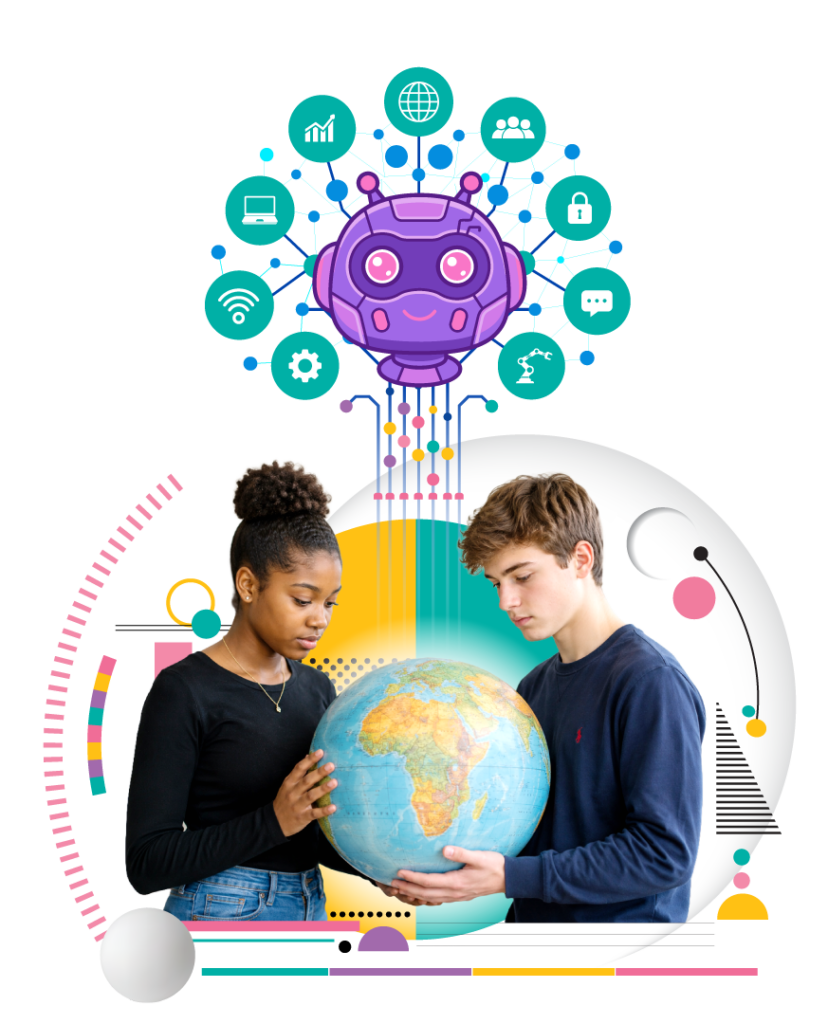
Machines have capabilities in the sense that they can process information, recognise patterns, generate text, optimise decisions, and increasingly perform tasks that once required human expertise. Their capabilities are expanding rapidly, but they remain fundamentally different from what it means for a person to inhabit the world.
Human beings do not simply perform functions. We experience uncertainty, wonder, attachment, responsibility, vulnerability, and care. We form relationships. We struggle with questions of identity and purpose. We imagine futures and grieve losses. We are not merely problem-solvers; we are meaning-makers.
Capabilities vs Capacities
As we live through a moment of profound transformation in the human condition, we need to become acutely aware of the evolution of the language we use to describe functionality, experiences, interactions, and relationships. Such awareness is essential if we are to use intelligent technologies for human flourishing rather than allow the quiet progression of the machinification of human development.
Although various forms of human–machine cognitive entanglement may be inevitable, educating young people to become machine-like is not an acceptable path.
Ultimately, the concern is not whether young people can compete with machines—in many areas, they will not be able to. Rather, the question is whether they can preserve and deepen those qualities that make human life worth living, even as machines become ever more capable. From this perspective, RippleVerse addresses a question that is less technological than civilisational:
How do we ensure that, as intelligent technologies become woven into everyday life, education continues to cultivate distinctly human ways of being in the world?
To this end, RippleVerse proposes a distinction between machine capabilities and human capacities, as illustrated in the table.
| Machine Capabilities | Human Capacities |
|---|---|
| Efficiency | Meaning-making |
| Optimisation | Judgement |
| Prediction | Imagination |
| Information Processing | Understanding |
| Execution | Responsibility |
| Pattern Recognition | Care |
| Computation | Experience |
| Instruction Following | Curiosity |
| Coding | Intentionality |
Beyond the Traditional 4Cs
For decades, educational discourse has emphasised the importance of the “4Cs”—critical thinking, communication, collaboration, and creativity—as essential skills for the twenty-first century.
RippleVerse recognises the importance of these ideas but argues that the age of intelligent machines requires us to reimagine these dimensions philosophically, socially, psychologically, and pedagogically, positioning them not as competencies to be acquired, but as ways of participating meaningfully in a rapidly changing world.
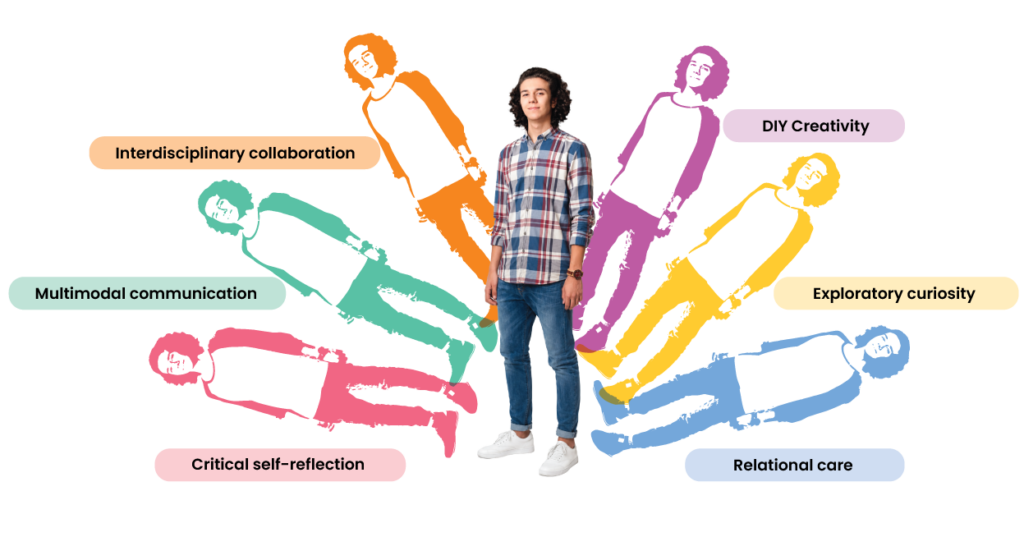
In RippleVerse, these dimensions are reconceptualised as functional operators for fostering human capacities, each carrying a distinct role in the development of individual agency through interactions with the surrounding world.
In RippleVerse, these capacities are understood as:
- critical self-reflection;
- multimodal communication;
- interdisciplinary collaboration;
- exploratory curiosity;
- relational care;
- DIY creativity.
By fostering these capacities, RippleVerse seeks to ensure that, as intelligent technologies continue to transform human life, education remains equally committed to cultivating the human capacities that allow young people to participate meaningfully in the world.
Machine capabilities expand what technology can do.
Human capacities expand who young people can become.