
RippleVerse Pedagogy
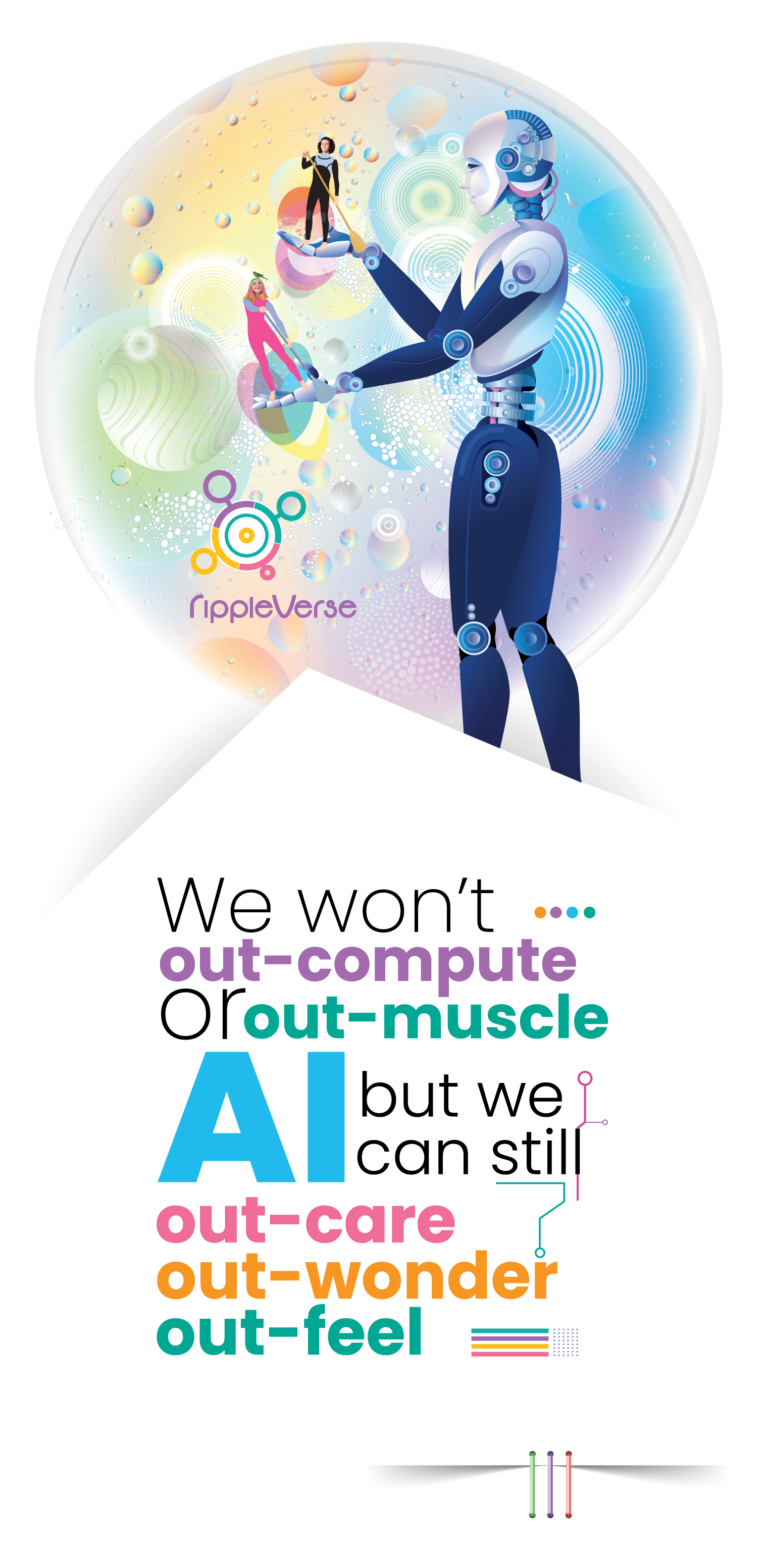
For the first time in history, humanity is building systems that can perform many activities that we once regarded as uniquely human: writing, composing music, generating images, tutoring, advising, and participating in conversation.
As machine capabilities continue to expand, RippleVerse asks a series of questions that are fundamentally human rather than technological:
- What kinds of relationships matter?
- What forms of understanding cannot be reduced to calculation?
- How do people develop a sense of purpose and responsibility?
- What does it mean to care for one another?
- How do we preserve wonder, imagination, and judgement?
To answer these questions, rather than withdrawing from technology, RippleVerse places its pedagogy directly within the human–machine interactions and asks whether we can create a new learning environment in which young people consciously explore who they are becoming and what it means to be in the world.
To become “more fully human” may involve cultivating capacities that machines can support but cannot themselves inhabit — at least not for now:
- the courage to act amid uncertainty;
- moral and ethical judgement;
- the search for belonging;
- the capacity to build relationships and communities;
- the experience of wonder and beauty;
- the ability to understand and respond to embodied experiences.
RippleVerse develops a unique learning ecosystem through which students explore themselves, their place in the world, and the kinds of individuals they are becoming, growing into twenty-first-century citizens capable of taking responsibility for themselves, for others, and for the world they share.

The RippleVerse Learning Ecosystem
and Cinematic Journaling
RippleVerse pedagogy is organised around dynamic interactions between individual inquiry, collaborative learning, AI engagement, and participation in effectively controlled simulated social-media-like spaces.
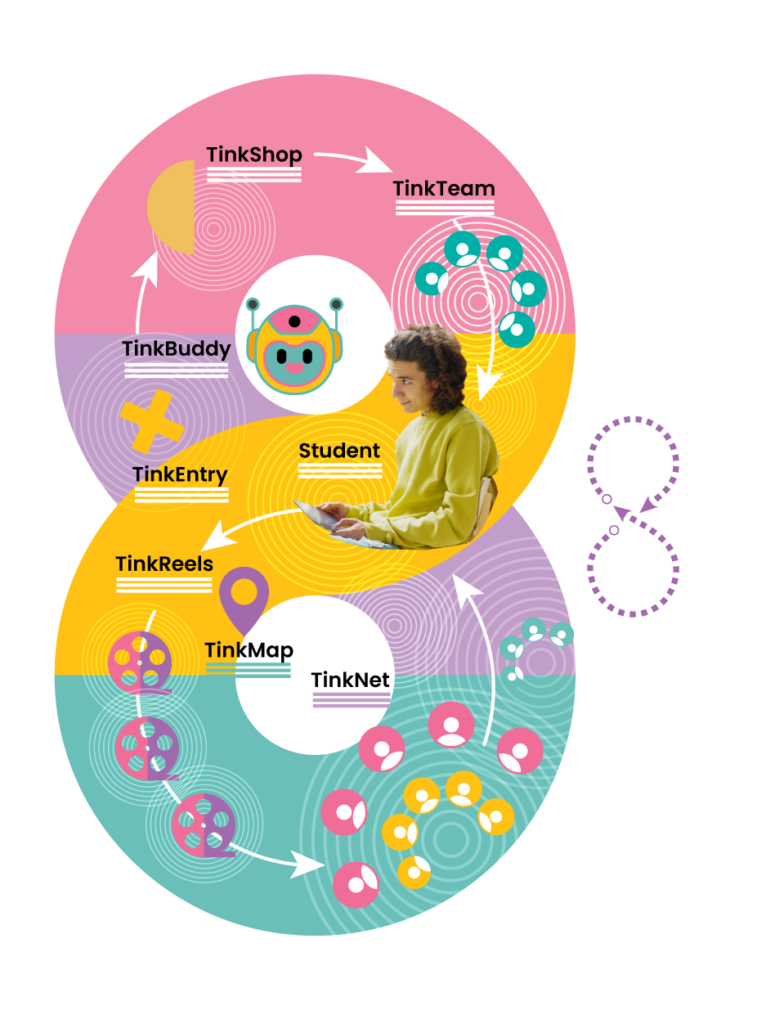
At its core lies a continuous cycle of reflection, creation, feedback, and knowledge development:
TinkEntry ↔ AI interactions (TinkBuddy) ↔ teamwork (ripplework) ↔ production of cinematic journal (TinkReel) and TinkMapping ↔ simulated social-media participation (TinkNet)
The names of the RippleVerse learning spaces begin with “Tink”, derived from the notion of tinkering—an approach to learning that values exploration, iteration, and discovery over the mere completion of tasks.
In RippleVerse, tinkering is understood as the opposite of outsourcing. Rather than handing over thinking to smart machines, students learn to engage actively with ideas, representations, and AI itself—questioning, revising, experimenting, and gradually refining both their understanding of the world and their understanding of themselves.
RippleVerse introduces TinkReels and TinkMapping: a novel form of Cinematic Journaling that captures learning as it unfolds through experimentation, collaboration, and dialogue across TinkShop, TinkBuddy, and TinkNet.
Through TinkMapping and TinkReeling, students externalise the process of knowing. RippleVerse understands know-ing as a continuous process of engaging with the world rather than merely accumulating knowledge.
In this way, learning becomes not the accumulation of information, but the cultivation of the capacity to navigate an increasingly uncertain and rapidly changing world.
Lifelong Learning
As economies become increasingly unpredictable and intelligent technologies continue to reshape work and society, young people need the capacity to recognise new opportunities, and identify what truly matters in a shifting world. But equally important, they need to know how to draw on their own strengths and potential—actively shaping new possibilities, not just responding to existing ones.
So, they’re not just prepared to adapt—they’re equipped to create their future.
Many educational models speak of lifelong learning as the willingness to keep acquiring new skills. RippleVerse seeks to cultivate something deeper: the ability to recognise learning opportunities embedded in everyday life and to weave them together with one’s own strengths, interests, and aspirations.
Through TinkReels, students learn to pause within the flow of experience and give form to it—transforming fleeting moments into cinematic artefact. By doing this, they don’t simply repeat others’ ideas—they actively shape their own unique understanding, developing a perspective that is authentically theirs.
In doing so, students do not simply document what they know. They learn to notice how their thinking develops, how new questions emerge, and how experiences can be transformed into resources for future learning and action.
TinkReels are therefore more than learning journals. They are tools through which students develop the capacity to direct their own intellectual and human development in a world of continuous change.